A Guide to Different Types of Zouk Classes
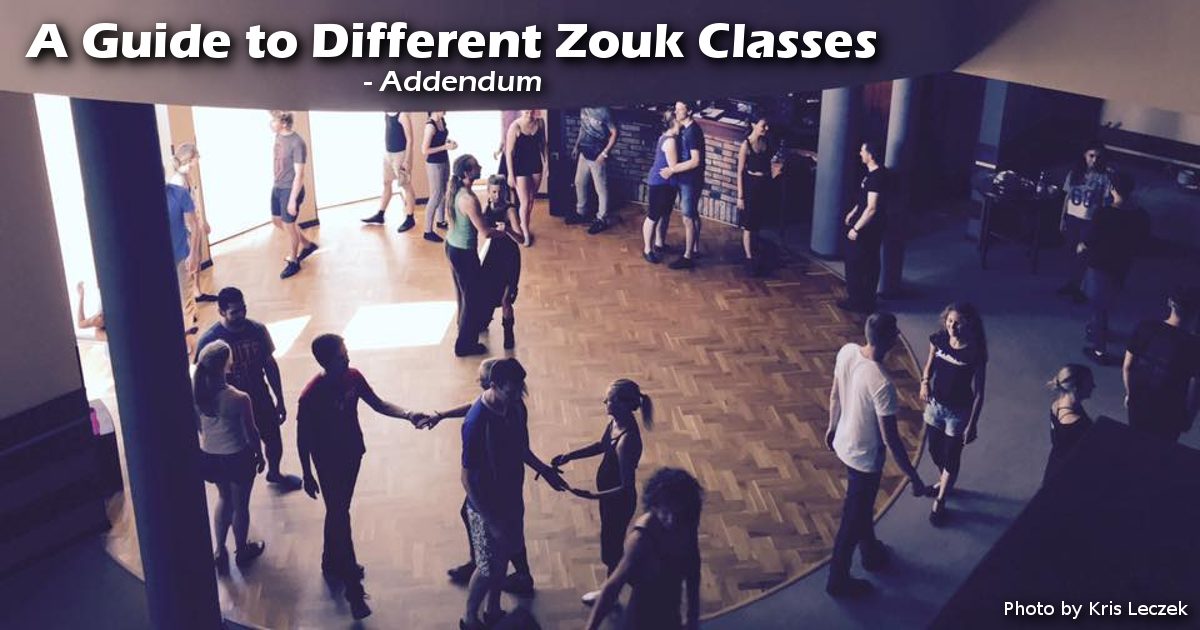
A Guide to Different Types of Zouk Classes - Part 1
Introduction
Dancing has been one of my greatest investments. With the correct nurturing and guidance, it will reward you for all the time, effort and money you’ve invested into achieving your desired results.
Over the years I’ve tried many different types of Zouk classes and courses, both locally in the UK and internationally.
In this series of blogs, I’ll share my thoughts on various learning methods, comparing the different class types and who they may be most suitable for.
Ideally, everyone should try every type of class or course and discover what works best for them. The most effective is generally finding the right balance of the different types of classes available. I hope that sharing my experiences will help you to make an informed decision prior to planning and investing your valuable time and money.
There will be 4-parts for easy digestion:
- Part 1:
- Progressive Courses
- Special One-Day Workshops and Congress Workshops
- Part 2:
- Bootcamps & Intensive Courses
- Privates Classes
- Part 3:
- Drop-in Bar Classes
- Part 4:
- Other Considerations & Final Words
Progressive Courses
My Definition: Typically pre-paid or require a registration and acceptance before you can join. 1-3 classes per week spanning over multiple weeks and you are expected to commit during the period of time.
Generally held in a dance studio or school with plenty of space, good flooring and mirrors.
Each course may cover a particular topic, technique or concept including a detailed breakdown. You should find that the teachers have planned your learning development so everything you learn is related to the rest of the course.
Levels can be monitored, but are typically open level, as the topics tend to focus on basic fundamentals. This may vary in some schools though…
You should find progressive courses being offered at your local dance schools.
Taught by: Ranges from Zouk enthusiasts to top professionals.
Who is this suitable for? Anyone, especially if you are looking to learn how to dance. This is even suitable for hobbyist and first timers. I would also still recommend them to experienced dancers because you can simply pick topics that you are weak on and focus your time on those. However, not all the topics that you may be seeking are available all the time.
Who this NOT suitable for? Probably not for highly experienced dancers, because if you are at that level then you would be better off investing in being exposed to the international dance world and looking for new inspirations, concepts and practice time with other dancers of similar experience. Also it doesn’t make sense for anyone who doesn’t live locally to the school as you need to be able to make a certain time commitment.
Speed of progression: Moderate
Discipline & commitment required: Moderate, 1-3 evenings per week.
My comments: It offers a good environment where most students are dedicated enough to turn up regularly and drills that may seem tedious in the eyes of most, but I find to be essential exercises in building the techniques needed to progress as a Zouk dancer.
I generally find progressive courses the best places for starters. The teachers don’t need to be top professionals or renowned artists. However, the person teaching the beginners class should actually be the best teacher at the school. Based on my experience, for someone to have the ability to teach the correct basic fundamentals to a beginner, they need to have vast dance experience and knowledge. Once beginners learn to walk properly, it’s generally easier for others to teach them and build on that strong foundation. But then again, that’s just my opinion.
Special One-Day Workshops and Congress Workshops
My Definition: These could be special one day workshops or workshops at congresses that are taught by professionals who have been invited to share a particular technique or concept and fill in the gaps in experience, knowledge or skills of the local teachers and Zouk enthusiasts. These are great opportunities for everyone of all experience levels unless there are competency prerequisites that need you to have an understanding of the Zouk basics. Although saying that, prerequisites rarely tend to be an issue as the people attending would have had local classes.
Taught by: Typically professionals and world renowned dance artists.
Who is this suitable for? All levels.
Who this not suitable for? Completely new beginners, because it’s kind of expected for you to have had a few local classes.
Speed of progression: Moderate
Discipline required: Moderate
My Comments: Over the last 5 years, the materials taught had evolved. Previously they were predominantly based on teaching movement patterns. At the time of writing this, they are more focused on teaching correct techniques and concepts.
I’ll discuss these important changes further in a separate blog and why I believe this is crucial in taking the global Zouk scene towards a healthier direction (not that it isn’t healthy currently, but there still are many underlying issues to tackle).
A Guide to Different Types of Zouk Classes - Part 2
This is part 2 of 4 of ‘A Guide to Different Types of Zouk Classes’.
Bootcamps & Intensive Courses
My Definition: Bootcamps are very structured and can range from being taught over a single weekend to a whole month. With smaller weekend boot camps focused on drilling a particular set of topics and longer curriculums progressively linking together all different aspect of dancing.
Class sizes are limited to ensure you receive adequate attention from the teachers throughout the training period. Most of the bootcamps I’ve been to work very hard to balance the gender ratio to promote equal development for leads and follows.
Taught by: Typically top professionals and world renowned dance artists.
Who is this suitable for? Depending on the intended audience, some bootcamps are designed for complete beginners, some for experienced and some for a mixture of all levels.
Who this not suitable for? Depends as above. Personally, all the bootcamps I’ve attended required you know how to lead or follow already.
Speed of progression: Moderate-Fast
Discipline & commitment required: High, for it to be highly effective. You’ll be spending a lot on travelling and spend entire weekends or weeks away.
My Comments: I love these bootcamps so much! They are by far one of the most incredible experiences and bang for my buck! I find them best value for money versus knowledge and experience gained. The bonus and gravy from doing bootcamps are the small size groups, which by the end would have given the chance to bond with nearly everyone.
I’ve had the chance to dance and practice with some truly amazing dancers from around the world, both in terms of passion and ability. Everyone is so humble and keen to learn which creates a resonating effect on each other. This is my ideal learning environment, the perfect balance of fun and challenging.
Privates Classes
My Definition:
Simple enough to explain. Privates are generally 1:1 but can also be 1:2 or 2:2 with paired instructors.
Taught by: Zouk enthusiasts to top professionals and world renowned dance artists.
Who is this suitable for? Everyone.
Who this not suitable for? Someone who is on a tight budget.
Speed of progression: Fast
Discipline & commitment required: High
My Comments: Privates are essential for constant development and growth, it’s very rare that I’ve met an outstanding dancer who hadn’t taken any privates before. The cost may seem astronomical per hour, but if you do your calculation correctly, it actually works out to be very cost effective.
Say you participate in one weekly class every week that costs you £10. Each class is an hour long and you get 2 sessions that evening. So that’s 2 hours for £10 = £5 per hour.
Assume the class size is 20 people. You have 2 teachers teaching you. So if the teacher splits their attention to half the class, then that’s 10 people per teacher.
In 1 hour, that teacher can spread their attention to 10 people (usually unequally), so that be average of 6 minutes of actual teacher’s attention to you for £5. Now, lets convert this to an hourly cost since most privates are charged per 60mins. 60mins / 6min = 10, therefore £5 x 10 = £50 per hour!
To get the most out of the privates, you should probably go in there knowing what you want to focus on. If you don’t, then you may just want to have a dance or two with the teacher during the private to identify your weakest points and what to focus on to give you the most improvement.
Most of my privates are always back to basics and correcting my axis, posture and weight shifting, with very little to do with actual leading and following. I had to learn how to move myself correctly first, before trying to move with a partner.
At the stage I am now (about 3.5 years of actual Zouk learning), I still utilise privates every 6 months to check if I’ve resolved previous bad habits and identify any new ones because it’s easy to pick up bad habits at any time.
A Guide to Different Types of Zouk Classes - Part 3
This is part 3 of 4 of ‘A Guide to Different Types of Zouk Classes’.
Drop-in Bar Classes
My Definition: Come when you want, stop when you want.
These are classes you will find taught in bars typically by Zouk enthusiasts and will have social dance hours after classes.
There tend to be 3-4 different levels; Beginners, Improvers (sometimes), Intermediate, Advanced.
(based on my experience in London, other countries may vary)
Taught by: Typically Zouk enthusiasts but you may get professional guest teachers on special occasions.
Who is this suitable for? First timers and hobbyists who just want to learn a few moves.
Who this NOT suitable for? Anyone who’s serious about learning how to dance Zouk.
Speed of progression: Low
Discipline & commitment required: Very little, whenever you are free.
My comments: Predominately based on teaching movement patterns. These are great for people who have never danced before and would like to sample what it could be like to social dance.
Bar classes have always been a popular and well utilised marketing tool to raise awareness of Zouk and bring new dancers into the community. However, they can draw in crowds where the people come more to relax and socialise after work than to learn how to dance. But then this class structure and environment does fit well with their reasons for being there.
For research purposes, I participated in intermediate and advanced drop in bar classes and my concern was that most of the students were trying to learn something way beyond their ability and really needed to go back to basics.
In my opinion, not only does this stop their own progression, it also selfishly impacts others. When the follower doesn’t know the basic movements she has to watch the teacher rather than feel the leading so the leader is never going to learn how to lead the movement correctly as the follower just automatically does the steps without waiting for the leading.
Also none of the followers at these classes are able to hold themselves even when walking in a line, they press their own weight and expect me to hold them up or keep them balanced. Therefore I would take the levels offered at these classes with a pinch of salt as they rarely reflect a student’s true ability or progression, but serve more as a feel good factor for the students.
I do understand levels are difficult to monitor and control, due to the inconsistency of new dancers joining and leaving each week, and many people attend bar classes just to relax after work, to socialise and have fun and aren’t particularly interested in becoming advanced technical dancers.
But at the same time Zouk can be a physically challenging and potentially dangerous dance form and for everyone’s health & safety and continued enjoyment, there are movements that should be taught or attempted by qualified professionals who understand the ramifications of exactly what they are teaching. For example - does any bar class teach weight transfer techniques, or how to control your own body or what skills are needed to become a light follow or a gentle leader? I haven’t seen this.
From what I’ve witnessed over the years, having this multi-levels system of beginners, improvers, intermediate, advanced, master classes etc only creates segregation and feeds egoism. There seem to be a lot of people who don’t like being stuck in one level for long periods of time or being told to stay in “Beginners”, and feel that they are better than what they really are.This over confidence in their lack of skills is very dangerous on the social dance floor.
Rather than having a level system that seems to feed egoism, there should just be a “Zouk Foundations Class”. That’s it! Only one level that you need to give you the skills to learn how to dance broken down into topics, techniques and concepts.
Having recently spoken to Willem Engel (the renowned teacher of teachers from the Netherlands) at the Masterclass & Teachers Course event, we had a discussion on some of the above issues and how this multi-level system will continue creating problems as the scene grows.
This conversation has helped re-enforce how I feel about this multi-level system that is often used throughout the world, a system that’s failing students.
A Guide to Different Types of Zouk Classes - Part 4
This is the 4th and final part of ‘A Guide to Different Types of Zouk Classes’.
Other Considerations
The effectiveness of the different courses and classes will certainly have many other factors including but not limited to;
The Teachers
- The limit of their experience, knowledge and understanding of the dance.
- A great dancer doesn’t necessarily make a great teacher.
- Everyone has their own preference of teaching styles that they are more receptive to.
- Whether a teacher continues to develop themselves is an important factor for me because the ones that don’t, tend to be left behind as Zouk is a constantly evolving dance. What they know today, may not be entirely valid tomorrow. This is particularly true because the more I have developed as a dancer, the more I realised what I don’t know and even what I thought I knew before were not entirely fully developed. A teacher is just another dancer with much to learn.
Ways around this: It’s simple: learn from as many different teachers as possible.
There is no such thing as loyalty when it comes to your self development and if the teachers are not looking out for your interest, then I would avoid them.
The best teachers are the ones who are guiding you in such way that it will bring out the best in you, as a person and as a dancer.
The students that are attending
- The ratio of male and female is important, where ideally equal ratio is the best.
- The level of each student also plays a factor. Ideally equal experience across the class, however this factor is one of the most difficult and almost impossible to control. If there are too many students with lesser experience taking a class far too difficult for them this tends to interrupt and stalls other students’ development and holds back the overall class progression.
- The size of the class also plays a huge factor. For obvious reasons, the smaller the class the better!
Ways around this: Tough one, it would require an iron fist teacher that people respect or a teacher who is articulate at letting students know they are not ready for a particular class level.
The easiest way is for students to do themself and everyone a favour by letting go of any egos. Set yourself a more realistic view of where you are really at with your dance skills.
This is also the main reason why I prefer learning techniques and concepts, because they are generally open level topics.
Your mood and mental state
- Fatigue and negative mood swings may affect your receptiveness and ability to absorb the information e.g. if you are too tired and mentally drained from work.
- If you are going through a tough time in your life trying to cope with stress and unhappiness.
Ways around this: Simply don’t dance until you’ve sort your sh!t out. There have been times in the past where I’ve tried to dance or go classes when I was stressed from work or staring down the pits of doom.
I found this to be a terrible idea because to me dance isn’t a place to escape when I was emotionally down. Deal with the problems in life, then come back to dance.
Dance is a place that I love to go when I am in a happy mental state. This is important because partner dancing is a share of emotions, and the last thing I want to do is spill over my unwanted negative feelings onto my dance partners.
Practice
- Actually practicing what you’ve learned.
- Too busy to find time to practice.
- Can’t find someone to practice with you.
- You still don’t know what you are doing.
Ways around this: Focus on only a few techniques and concepts at a time. Avoid procrastination by parking that long list of different things you’ve learned from taking hundreds of classes.
Practice on your own; twerk at your desk, engage that core, feel where your axis is, watch your weight transfer and footwork as walk to work, do body isolations everywhere and anywhere!
Most beginners will feel that they need a partner to practice because it’s a “partner” dance. WRONG. The thing you need to practice all the time is how to control your own body; your footwork, where your axis is as you shift it along with weight transfer, and actively being aware of your body parts (isolations) can all be done out of class.
If you don’t know what you should be practicing, then what have you been learning in class? If you’ve learned nothing in class, then ask yourself why? Have you asked questions and got an explanation that makes sense to you? If all that fails, then I think it’s time for you try a different teacher (no, this isn’t an excuse to level jump!)
No excuses for not practicing now. :)
Final Words
There you have it, plenty of options depending on what you are looking for.
If your preference is convenience and learning a few moves on a dance floor is what you want, then it goes without saying which classes are suited for you.
However, for those of you looking to learn how to dance, the price you pay for travelling, attending bootcamps and doing privates, are in fact the more time/cost effective!
At the end of the day, it’s your choice. For me, time is something I value the most and am very careful how to spend it.
Thank you for reading. Hoi from DZ.