AI Managed Harness Services
I help non-technical domain experts and subject matter experts (SME) adopt AI properly. Not by handing you a tool and saying “off you go”. Not by writing a hand-wavy AI strategy deck either! My strength is people and moving parts: a serial entrepreneur who has run real businesses, a qualified project manager who was PMP certified (PMI, 2023), with donkey years of programme management on projects of scale.
Plainly: I write software with AI, and use it to build automation workflows around the way your business actually works.
Frankly speaking, I am not here to scale your AWS or your other cloud infrastructure (that’s your tech team’s job!). I am here to help the people who actually do the work in your business (marketing, sales, ops, design, finance, customer support, wherever you sit) integrate a custom AI harness that automates the routine, so you can focus on your human ingenuity, your domain expertise and subject matter expertise (the things AI cannot replicate, now or any time soon).
There is a right way and a wrong way to use AI. Getting AI to work consistently in a real business takes a long time to figure out. The good news: I have spent that time already, so you do not have to.
This is a sequential, audit-first engagement. It starts at £1,500 and builds on what already exists in your business (sometimes more than you think it does). I make sure your AI tooling becomes a working harness, then I keep it working.
Book a 20-min discovery call <-- (Recruiters: please do not click. Please click if you are a fun-yet-serious decision maker or their trusted second, who has no time for bullshit and needs to get things done.)
Who this is for
Owner-operator CEOs and startup founders running 5 to 50 employee businesses. Founder-led. Sometimes with a small team, sometimes solo on the operator side. The team can sit on any side of the business: ops, sales, marketing, customer support, design, finance, engineering, or some mix of those. The common thread is wanting to actually adopt AI effectively. If your current experience is the demo-grade kind (works in playgrounds, misses the brief in real work, hallucinates, needs babysitting), you can probably feel the gap already.
Bigger than that? If you are a medium or large business, I still work with you, just at the subject-matter level rather than the domain level. That means I harness specific teams or roles inside your business, not the whole cross-team workflow end to end. (If that distinction is not clear yet, I explain it properly in Two kinds of expert, and why you want both harnessed further down.)
With or without a CTO is fine. If you already have one, I work alongside them as an extension (an extra pair of senior hands and a harness pattern that lifts what they are already doing). If you do not, I cover the AI-tooling architecture lane until you decide whether you need a permanent technical hire. Either way, you make AI-spend decisions yourself and you do not need to convince a board.
You feel the AI-tooling drift. You know Claude (or ChatGPT, Cursor, Copilot, Notion AI, or whichever tool the smart people on YouTube were excited about last month) works in demos only but not consistently. You bought the courses. You read the threads. You sense there is a real productivity tool buried in this technology that nobody on your team has the time to architect properly.
You probably feel understaffed. You are always under pressure. Things slip through the cracks because the team is running too lean, and the slippage compounds (you can feel it). That is when bringing me in starts to make sense. Not to hire more humans (expensive, slow to onboard, adds management overhead), but to automate the work that does not need a human in the first place. Same team, more output, less drained.
Your decisions land in days, not quarters, which is exactly why this engagement shape works for you.
Who I work with
This is going to be a long-ish journey (audit, foundation, multiple harnesses, ongoing maintenance, often more than a year) and I would rather we both have fun along the way. The work itself is going to be hard and sometimes stressful. The last thing we both need is more seriousness breathing down our necks.
So: I work best with people who are down-to-earth, empathetic, real, connected, and grounded. People who treat this as a partnership rather than a vendor relationship. People who can laugh at the absurdity of a Claude session that confidently invented functions that did not exist, and then get on with fixing it.
People I have worked with label me as the “No Problems, Only Solutions” guy, and I happily live up to that. I am dead serious about the work itself (quality output, delivered on time, no shortcuts on what matters). I am NOT serious about the rest of it. There will be a sprinkle of sarcasm. I will tell you when something is genuinely funny. I will admit when I have cocked something up.
Staying calm, light-hearted, leaning into humour and sarcasm has always been my way of processing high stress and survival instinct (especially during fire-fighting situations). So if that is a problem for you or your stakeholders, then yeah, it will not work for us.
We both have to choose to work with each other and the right working environment for both of us to do our best work. Otherwise it is not going forward. If reading my genuine voice and persona on this page lands for you, we will probably have a great time and not just get shit done (anyone can do that), but get shit done PROPERLY. If it makes you cringe, I am almost certainly not the consultant for you (and that is also completely fine, I am not for everyone). If that is you, no hard feelings; we are probably not the right consultant-and-client match, and the discovery call will not change that.
I’m a firm believer that starting any relationship with the highest honesty and integrity, and continuing on that basis, is the right way. It’ll keep us all sane :)
If you are still with me, keep going. The rest of this page is not selling. It is information to set and manage your expectations: what we will do, why, how, and when.
What is an AI harness, in one diagram
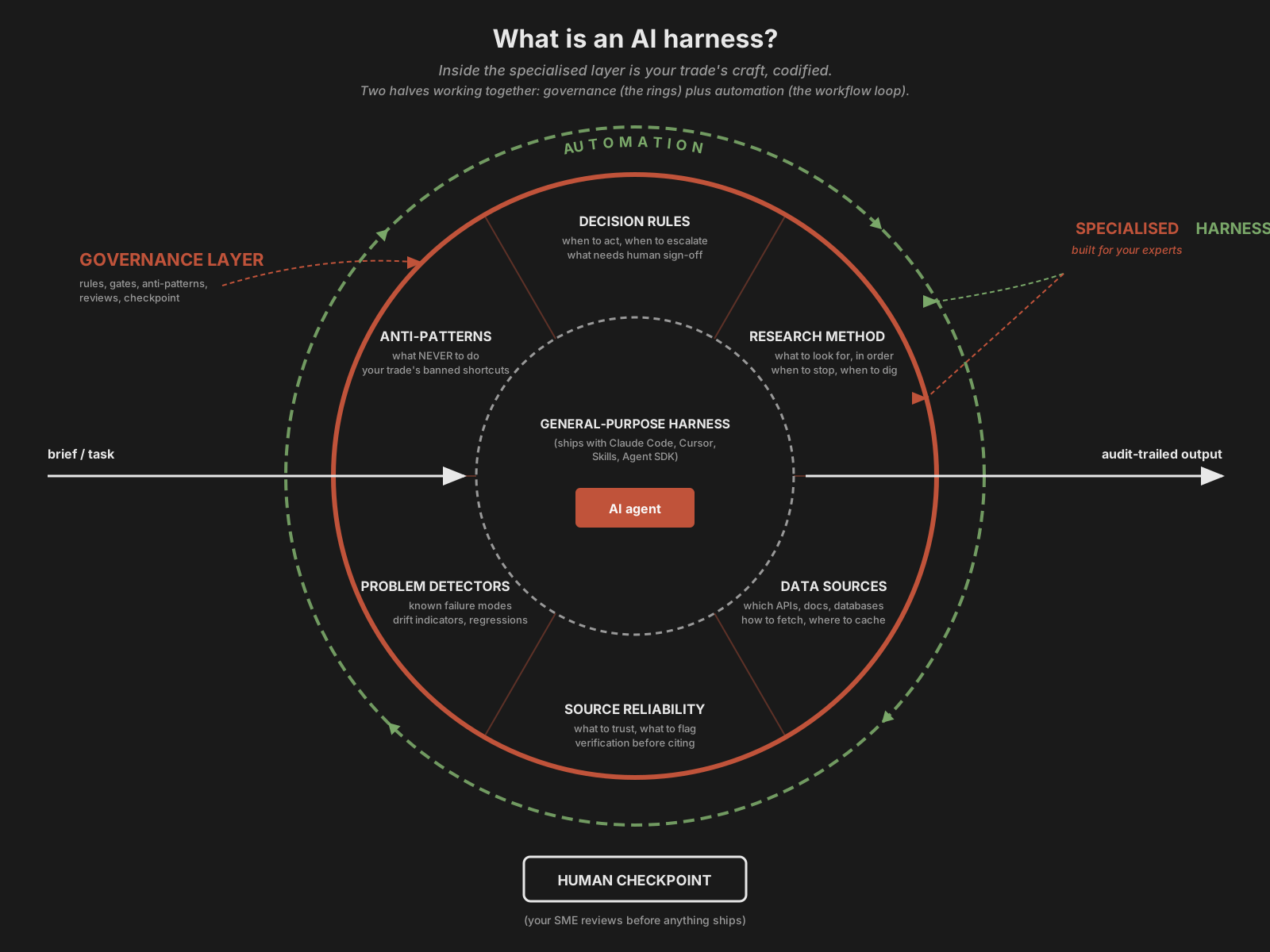
(Click the diagram to enlarge for details.)
What is an AI harness, and why do you need one?
Short version: a harness is a custom-built wrapper around your chosen AI tools (Claude, ChatGPT, Cursor, Copilot, whatever you use), shaped to your business’s actual work. Without one, AI is a clever assistant that occasionally forgets things and occasionally (mostly) hallucinates. With one, AI becomes a consistent, audit-trailed colleague that does the routine work the way YOU need it done. The difference between “fun in demos” and “actually useful every day”.
(See the diagram just above: two concentric layers, six labelled segments in the specialised outer ring, AI agent at the centre, your human checkpoint outside.)
The “why do you need one” answer in plain English: it turns your subject matter experts into amplified versions of themselves. A meaningful chunk of every SME’s week goes on work that is repeatable, well-understood, and (honestly) a poor use of their hours. Recurring spreadsheets. Compliance checks. Listing formats. Brief-to-copy translations. Audit reconciliations. Necessary work, done a thousand times manually. The SME is the right person to DESIGN the workflow that handles it. Running it by hand a thousand times is what the harness takes off their plate.
The harness digitises and automates that bottom layer. It runs the repeatable parts of their day as workflows the AI executes reliably, gated by your standards. Your SME stops being the person who DOES the routine work, and becomes the person who DIRECTS, REVIEWS, and applies their actual expertise on top. The thinking. The strategic calls. The customer relationships. The judgement calls only somebody with a decade in the trade can make. The bits AI cannot replicate, now or any time soon.
A hero suit, basically. The harness is the suit. Your SME is still the one calling the shots. The suit amplifies. Same headcount, more output, less drained. Picture Iron Man: it is a suit that still needs the hero to wear it.
Why not just go full automation and replace the human entirely? Android instead of cyborg? Good question if that is what you are thinking. Ask yourself: with the state of AI today, would you put 100% faith and trust in AI? (You have probably seen the stories of AI deleting a company’s entire production database in 9 seconds. Not here to scaremonger. That was almost certainly poor architecture and giving AI full control over every layer. That is just dumb.) Right now a hero suit makes more sense. We still need the human in the loop. The human orchestrator. The subject matter expert who can sanity-check that the AI is doing it right, steer it through small errors and refinements, and make the calls that should not be made by AI and need the kind of complex thought only humans bring. In the not-so-distant future, yes, full human replacement is almost certainly coming. Just not where AI is right now.
How does the harness actually pull that off? Two halves working together.
Automation half. Every business has work that is complex but repeatable. The harness takes those workflows, breaks them into smaller automation pieces, and stitches them back together as a sequence the AI runs reliably every time. Same input, same shape, same quality. Every time.
Governance half. Without this layer, automation just generates slop faster. The harness wraps the workflow in rules, anti-patterns, validators, voice checks, evidence-enforced approvals, fail-loud guardrails, and a three-tier review. Every output passes through that gate BEFORE it reaches the human-in-the-loop checkpoint at the end. Your reviewer signs off what the harness has already vetted, instead of red-penning everything from scratch.
Both halves matter. Automation without governance is a faster way to ship rubbish. Governance without automation is a thicker rule book nobody follows. Together they make the AI accountable AND the SME productive.
Worth being precise about which harness we are talking about, because there are layers. Modern AI tools (Claude Code, Cursor, Copilot, ChatGPT, the lot) already ship with their own general-purpose harnesses underneath, which is what makes them roughly useful for everyone in roughly the same way. The harness I build for you sits ON TOP of that. It is the specialised layer for YOUR business: your workflows, your governance, your domain and subject matter expertise, your competitive edge.
A common confusion: people see Anthropic’s Skills (or similar plug-in spec files from other vendors) and think those ARE a harness. Skills are a PART of a harness. Useful on their own, inadequate alone. A full harness is workflow plus governance plus Skills plus feedback loops plus role-specific automation, all glued together. And here is the bit that matters for your edge: every company does things slightly differently, and the ones that PULL ahead do things differently on purpose. That “doing it differently” lives in the specialised harness. An off-the-shelf SKU cannot ship that for you, because it is built for everyone, not for you.
Want to dig into the concept before booking a call? Three posts of mine that go deeper:
- Why Do We Need an AI Harness? (15 Apr 2026)
- Every Domain Expert Needs Their Own AI Harness (21 Apr 2026)
- SST3-AI-Harness. Why I Built a Hero Suit for AI. (14 Apr 2026)
Two kinds of expert, and why you want both harnessed
Quick clarification, because not everyone draws this line and the two get muddled. A domain expert is the person who understands the whole business workflow, end to end, across teams. How the pieces connect, how work flows from sales to ops to finance to delivery. The big picture of how your business actually runs. A subject matter expert (SME) is the person deep in one specific subject or process inside that workflow. The finance lead who knows reconciliations cold. The marketer who lives in brief-to-copy. The ops person who owns the listing format. Narrow, but they know their corner better than anyone.
You want automation for both, and they are not the same job.
The domain-level harness automates the business workflow that runs across teams. The handoffs, the cross-team process, the thing that usually lives in your head as the founder (or in a messy spreadsheet nobody fully trusts). Get that right and the whole business moves more smoothly, not just one corner of it.
The subject-matter-level harness automates the deep, repetitive work inside a single team or role, so that team operates faster and cleaner within the bigger workflow. The SME stops grinding through the repeatable parts by hand and gets their hours back for the judgement work only they can do.
Both matter, equally. The domain harness makes the business flow. The subject-matter harnesses make each team sharp inside that flow. One without the other leaves value sitting there: a smooth cross-team process still jams if every team is drowning in manual work, and a brilliantly efficient team still loses hours if the work bounces awkwardly between departments.
Here is the gap most people miss. Almost all of the agentic AI work out there aims at the domain level: big, cross-team, business-wide automation. Very little of it (sometimes none) goes deep at the subject-matter level, where the actual daily grind lives. That is exactly where I focus, and where I am strongest.
A practical note on size. For domain-level work (mapping and harnessing the whole cross-team business workflow) I prefer small, founder-led businesses and startups (the owner-operator shape this page is built for, roughly up to 50 employees), where I can realistically get my arms around the end-to-end flow. For subject-matter-level work (harnessing one specific team or role) I can help a business of any size, because that work scopes to a single team’s process, not the whole company.
So when I audit your company (Phase 2 below), part of what I am mapping is exactly this: where the domain-level workflow lives, and which subject-matter roles need their own harness inside it. Then we build both, in the right order.
“Why Claude Code (and not the other Claude products)?”
I focus on Claude Code specifically. Anthropic has a growing menu of Claude products tailored to specific roles or use cases (Claude Desktop, Claude Cowork, Claude Design, Claude whatever launches next), and they all have their place. But once your team learns Claude Code, it covers ALL of those use cases (and a hundred more your business has not thought of yet) from one tool, set up once, harnessed properly.
Claude Code does not have a pretty point-and-click UI, and that is for a good reason: it does not need one. Set up correctly and harnessed properly, it is simply powerful. You get an enormously flexible agent that runs anything from “draft me a customer reply” to “audit the last quarter’s contracts” to “wire up a workflow that reconciles three internal systems automatically”. It does everything the specialised Claude products do, and a whole lot more.
That is what I am betting my consultancy on. One tool, learned well, harnessed well, applied across every side of your business.
Most tasks and workflows can be automated. Take an example I am working on right now: Blender and SketchUp 3D modelling for an architecture practice, to speed up building 3D concept designs that take 2D drawings and a collection of furniture-and-fitting ideas and transform them autonomously. The only thing you should be thinking and asking yourself: “What can we automate?” and “What can’t be automated yet?” and “What shouldn’t we automate for good reasons?”
I also want to say that I picked the best of the best at the time for coding, and Claude Code has since become even more of a beast at getting shit done, not just for coding but for other workloads too. I tried others a little, but nah. Also, focus is important. My harness took a long time and lots of refactoring to get right. Throwing in more variables (Codex, or whatever other CLI-based AI option) would have just burned both money and resources for little gain in value. I stuck with Claude Code because I know it works, and works really well.
“What problem am I solving for you?”
Building a proper AI harness (with all the necessary workflows, guardrails, governance, enforcements, feedback loops, and the dozen other moving parts that make AI actually useful inside a business) requires more than a full-time job. It is a real specialism.
I have been at it 12 to 15 hours a day every day for the last year, on top of two years of “normal” daily use before that. AI is fast-changing, the goalposts keep moving (new models, new tools, new best practices, every quarter), and keeping a working harness in shape requires staying on top of all of it.
So: expecting a non-technical subject matter expert (whose actual expertise is marketing, sales, ops, design, finance, customer support, or whatever side of the business they sit on) to learn all of that on top of their day job? No wonder so many people are struggling with AI adoption. Your team are not engineers. They were not hired to spend their evenings on YouTube learning how to wrangle Claude.
That is the problem I am solving for you. Your subject matter experts are there to do what they are good at, and they should stay focused on that. Leave the harness and the workflow design to people like me who have spent way too much of our spare time playing around with AI (because yeah it is fun, but also frustrating at times). I bring the harness pattern, the workflow design, the governance, and the ongoing maintenance into your business as a service, so your people can do their actual jobs.
One more thing worth knowing: the harness is more independent than you might think. Picture it as a wrapper, a piece of kit the AI agent wears, with the workflows, guardrails, governance, and feedback loops baked into the wrapper itself. Once it is shipped and working, it does not change much. New models come along (Claude Opus 4.6 to 4.7, and whatever comes after), and based on what I have seen so far those upgrades tend to make the harness work better, not break it. Some tweaks may be needed when a new model lands (the Monthly Maintenance Package handles that), but no wholesale rebuilds.
So your domain expert’s day-to-day with the harness in place: the routine work gets handled consistently (with the right enforcement and audit trail), and they spend their hours on the human-judgment work AI cannot replicate (the creative calls, the customer relationships, the strategic decisions). Faster output, higher quality, same headcount, same people doing what they are best at.
“Why is a managed service offer on a blog site?”
Fair question. Because I could spin up a fancy “AI consultancy” website in a day (templated trust signals, stock photography, an “Our Process” section in a sans-serif font, you’ve seen it). Gold foil wrapping and the full sales pitch from a true salesman who talks big but isn’t the one delivering it. You do not want any of that. You want someone genuinely good at the actual work, who delivers on time, at high quality, and goes above and beyond when the audit surfaces something you did not expect.
So that is what I am offering, on my actual blog where you can read who I am, what I am, what I am not, what I think about, what I build, what I cock up, what I learn. Reading me here is easier than reading a pitch deck someone else wrote for me.
As a bonus you get my bubbly, fun, no-bullshit (maybe a sprinkle of sarcasm) personality. We will figure out on a 20-minute discovery call whether working together is going to be a wonderful and pleasurable experience for both of us, well before any money or SOW (Statement of Work; the legal contract that locks the scope, deliverables, fees, and terms of a phase) lands on the table.
No slide deck, no sales pitch on that call. I am more interested in listening to your problems and helping you solve them.
And while we are on this. The bigger problem with AI right now is people spending too much time making things LOOK nice that do not actually WORK. The pretty UI on top of the broken bit. The demo that landed on camera after take 17 (and the previous 16 takes you never saw). The “I built a full platform in 1 day with AI” that looks super fancy on a Youtube video (you’ve seen the genre).
I am not running that play. It’s like trying to wrap shit in gold, but end of the day it is still shit. That’s basically what AI slop is and I’m sure you know all about it and trying to solve it since you’re on my page reading this. I would rather spend my hours building the thing that works (audit, foundation, per-harness build and rollout, ongoing maintenance) because right now, this is what matters. Yes, I will automate the bits of my own marketing where automation makes genuine sense, and yes this page will keep getting a little nicer over time. But the value is not in covering up problems. The value is focussing on something that works reliably, now AND in 12 months, with the minimum maintenance burden possible. That is the actual problem to solve.
That is what I am building for you. Not a pretty thing. A working thing.
“Are you a one-man band?”
Yes and I won’t be changing this! I had businesses where I managed large teams (which is its own full-time job, and a different one to actually doing the work). With AI assistants doing the heavy lifting now, I genuinely do not need that overhead any more. The AI is the team working for me. So now I can focus on what I’m passionate about: being out there helping you on the ground, sharing my expertise!
How it works
I deliver this sequentially, one step at a time, never parallel. Each step closes before the next opens. You can pull out at any handover.
- Free 20-minute discovery call (Cal.com booking, Mon to Fri, UK business hours). Tell me your business shape, your AI usage today, what you wish worked better, and how you imagine AI working for you in your head (the result you picture, the workflow you imagine, the daily-life-with-AI you would like to have). That last part lets me set honest expectations and surface any alignment or misalignment between what you imagine and what is realistic right now, well before any money or SOW lands. I tell you whether this is a fit, fast.
- Company structure audit (1 to 3 days, written report plus walkthrough call). Three tiers: £1,500 + VAT for 5 to 10 employees. £2,500 + VAT for 10 to 50 employees. £4,500-£5,000 + VAT for 50+ employees (range, scoped on the discovery call). The audit produces an understanding of your company structure (layers, unique roles), whether we are trialing on a single department first (in which case the audit focuses there), the count of unique harnesses to build (one per distinct role or workflow), the best engagement contact on your side I will coordinate with through the build, and the SMEs I will be sitting with for each per-harness audit later. It also produces high-level enough understanding to structure the foundation that will support those harnesses. Plus a directional budget for the whole engagement, calculated as harness count multiplied by the medium of the per-harness £12K-£30K typical band, just a starting frame to set expectations. The number is also useful on your side for cost planning: deriving cost per head across your team, measuring performance improvement against the spend, or however else you frame cost-versus-value internally (which is your business, not my remit). I will not invent a “300% productivity boost” multiplier to dress the budget up. Performance gain is something you measure over time on your own terms, not a number I make up to close a deal. What I can confidently commit to: what I am building will drive productivity up over the long run and gap-fill the efficiency holes that exist in your day-to-day work today. It is just a budget. Some harnesses run more, some less; firm per-harness fees lock in at Phase 4 (Per-harness audit) once I sit with the SME and see the workflow detail. We drawdown from the budget as we build Phases 4 to 6 and adjust if reality skewers the medium. 1 to 3 days is not enough time for per-harness deep-dive; this is high-level structural understanding to set engagement direction. The audit is independent (it is not credited back against build work later, because that would compromise auditor independence).
- Foundation setup (£3,000 + VAT for 2 days fixed; overflow at £1,500/extra day, hard-capped at 4 days total). The scaffolding that every harness sits on top of: a clean home in your GitHub for each harness with proper version history, rollback, and audit trail, plus the security controls that keep your company information safe and contained. Future-improvement recommendations come naturally out of working with the harness in your day-to-day (those recommendations are out-of-scope as billable work, but I will surface them so you can decide what to act on).
- Per-harness audit (£750 + VAT, one SME-day, where SME means Subject Matter Expert; the consultancy-industry billing unit for one full day of an expert’s time). Sequential, one per harness, before each build. What actually happens on the day: I shadow your SME, pick their brain, ask lots of questions. I want to understand three things at the core: what they want automating, what cannot be automated, and what should not be automated even if it technically could. I want to understand where their data comes from, how they crunch it, how they analyse it, how they make it useful, and how they want it presented. All in plain English. I am not going to dress it up with clever acronyms (RAG, LLM Wiki, vector embeddings, knowledge graphs, agentic this and that). I focus on what matters to the SME, not what sounds clever (or makes me sound clever, duh). What they are designing, what they are building, what tools they use day-to-day, what is genuinely hard about their job. The goal is to learn enough that I could roughly play their role. If a particular role turns out more complicated than one SME-day allows, we discuss and agree an extension at the same SME-day rate (half-day minimum: any extension is charged in half-day chunks, not by the hour).
- Per-harness build and rollout, custom-scoped per audit (the audit tells us what to build AND how many users we are rolling it out to; the build itself is shaped by the rollout shape, so building a harness for 1 user is a different job from the same harness rolled out across 20). I will not pre-quote it for that reason. Typical band £12K-£30K + VAT depending on harness complexity AND rollout footprint (number of users on your team running it).
- SME harness manual and tutoring workshop, per harness (£750 + VAT, one SME-day). Once the harness ships, your subject matter experts get a hands-on session so they can actually USE it confidently. I walk them through the harness, the workflows, the guardrails, the failure modes to watch for, and the bits where they should and should not push back. The manual is also baked INTO the harness itself, so anyone on your team can ask the harness “how do I use you for X?” and get an answer back rooted in your trade’s actual rules. No 20-page PDF that nobody reads.
- Tier 1 first-month support, per harness (free, capped at 8 hours of my time across the first month post-workshop). Reactive help with anything that surfaces while your team gets used to the harness in their day-to-day. Not full-time on-call availability.
- Ongoing Monthly Maintenance Package, per harness, deliverable-anchored (NOT a retainer; you pay for closed drift events plus the monthly maintenance report, not for me being on standby). Priced low on purpose: £200/mo per harness + VAT month-to-month, or £170/mo per harness + VAT on a 12-month annual commit. Once the harness is shipped and working this is genuinely light-touch, so the price stays low and you decide every month whether it is still earning its place. Month-to-month, 14-day notice either way: keep it while it is worth it to you, drop it the moment it is not. Covers AI model drift (e.g. Claude Opus 4.6->4.7), dependency drift, configuration drift. Not feature work.
- Anything outside the current SOW (new features, enhancements, additional harnesses, mid-engagement scope changes). Treated as a new engagement. Anything significant goes through a fresh per-harness audit (£750 + VAT, one SME-day) to scope the change properly, then a custom-quoted build SOW. Smaller pieces of work (half-day to a couple of days, not big enough to warrant a fresh audit) can be billed pro-rata against the SME-day rate (£750 + VAT per SME-day, half-day minimum). Change-orders that qualify as maintenance can sometimes run under the Tier 2 hourly pack if you have one. Same audit-first discipline as the original engagement: I will not pre-quote work I have not scoped.
Need open-scope hours portfolio-wide instead of the monthly maintenance package? Tier 2 hourly pack: £1,500 / 10 hours + VAT. Existing clients only (you already have at least one harness shipped) and maintenance-only scope (drift events, support, troubleshooting). Feature work or new harness builds run as their own per-harness audit + build SOW, not under this pack.
Per-harness builds and rollouts typically land between £12K and £30K + VAT depending on harness complexity AND rollout footprint (number of users on your team running the same harness; the build itself is shaped by how many users it needs to land on, so this is a single fee covering both dimensions, not a build fee plus a separate per-user rollout fee). The Phase 2 company audit gives you a directional engagement-level budget (harness count × the medium of this band, just a starting frame). Firm per-harness fees lock in at Phase 4 (Per-harness audit) once I sit with the SME and see the workflow detail. The build fee is a fixed-fee output of the per-harness audit, not an open hourly tab. Volume discounts may apply for multi-harness commitments at engagement open, discussed on the audit walkthrough call. The Monthly Maintenance Package and hourly pack ARE fully published; those are commodity-shaped.
Pricing Matrix
At a glance. All prices exclude VAT (charged at the prevailing rate; VAT-registered from invoice #1).
| Phase | Price | Notes |
|---|---|---|
| 1. Discovery call | Free | 20-minute Cal.com booking, Mon to Fri UK business hours |
| 2. Company audit | £1,500 (5-10 emp) / £2,500 (10-50 emp) / £4,500-5,000 (50+ emp) | 1-3 SME-days; written report + walkthrough call; independent (not credited back against build) |
| 3. Foundation setup | £3,000 base 2 days; £1,500/extra day, hard-capped at 4 days total (£6,000 max) | Per-harness scaffolding: clean GitHub home, version history, rollback, audit trail, security controls |
| 4. Per-harness audit | £750 per harness | 1 SME-day; sequential, one per harness, before each build |
| 5. Per-harness build and rollout | £12K-£30K typical (fixed-fee output of audit; scales with rollout footprint) | Custom-scoped per audit; build is shaped by rollout shape (1-user harness vs 20-user harness = different jobs); single fee covers both dimensions; volume discount for multi-harness commitments at engagement open |
| 6. SME harness manual + tutoring workshop | £750 per harness | One SME-day post-build; hands-on training for your team; manual baked INTO the harness so it answers “how do I use you?” on demand |
| 7. Tier 1 first-month support | Free | 8 hours of my time per harness across the first calendar month post-workshop (not full-time availability) |
| 8. Tier 3 Monthly Maintenance Package | £200/mo per harness on month-to-month, or £170/mo per harness on a 12-month annual commit | Deliverable-anchored: closed drift events + monthly report (NOT a retainer, NOT hours-metered); covers AI model / dependency / configuration drift; not feature work. Effort cap (my side, internal): up to 2.5 hours per harness per month; overage rate £150/h, agreed in writing on the engagement Issue before I exceed the cap; unused hours do NOT roll over month-to-month; 14-day termination notice either side |
| 9. Out-of-scope work (new features, additional harnesses, mid-engagement changes) | Significant: fresh audit (£750/SME-day) + custom-quoted build SOW. Smaller pieces: pro-rata £750/SME-day, half-day minimum | Same audit-first discipline as the original engagement; maintenance-scoped change-orders may qualify for Tier 2 hourly pack if you have one |
| Optional. Tier 2 hourly pack | £1,500 / 10 hours | Existing clients only (must have at least one harness shipped); maintenance scope only |
What I cover (absorbed in the phase fees, not separately billed): all AI tooling costs for my own work. Claude Max subscriptions, Anthropic API top-ups, MCP server hosting, agent-orchestration overhead during build phases and under the Monthly Maintenance Package or Tier 2 hourly pack.
What you cover (your own subscription with Anthropic, separate from anything I bill you for): your team’s everyday production use of the shipped harness. Recommend Claude Max 20x per user, or whichever Anthropic tier fits your usage agreement.
Billing
How and when I bill, in plain terms. The structure protects both sides: you do not pay before there is real value committed, and I do not carry months of work-in-progress without cashflow.
Upfront, before work starts
Two phases get billed upfront, on engagement open:
- Phase 2 Company audit. Invoiced and paid before the audit begins. Upfront billing keeps both sides serious. You are not buying a slide deck; you are commissioning real research that lands in your hands whether you proceed past it or not. (For what the audit actually produces, see the How it works section above.)
- Phase 3 Foundation setup. Invoiced and paid before foundation work begins, after you have seen the audit and accepted the budget (with whatever adjustments we discuss). Foundation is significant scope; upfront billing matches the commitment level.
Rolling monthly, for ongoing build phases
Phases 4 (per-harness audit), 5 (per-harness build and rollout), and 6 (SME workshop) are billed on a rolling monthly basis, pro-rata for whatever was completed and signed off in that calendar month.
How it works in practice:
- My work month runs the 1st through end of month
- At the end of each calendar month, I send an invoice covering everything completed and signed off during that month, whether that is full harnesses or partial-build milestones for a harness still mid-build
- Sign-off is the gate: each deliverable (harness or milestone) needs your “yes, I am happy with this” before it goes on the invoice. No surprise charges
- For smaller harnesses (audit + build + workshop fits inside one calendar month), the bill lands in that single month after the workshop signs off
- For larger harnesses (longer build cycles, more rollout users, more complex workflows), we agree milestones at build kickoff (typical breakdown: scaffolding, core build, rollout per user cohort, workshop). Each signed-off milestone bills in whatever calendar month it lands. A 3-month harness might bill across 3 separate calendar months, so you pay as we make signed-off progress instead of one lump at the end
The reason for monthly pro-rata instead of “pay at the end of everything”: cashflow on my side, fair pacing on yours. If your engagement runs 3 to 6 months across multiple harnesses, neither of us wants to sit on a single huge bill at the end. Rolling monthly keeps both sides honest about what is actually shipping.
Recurring, for ongoing maintenance
Phase 8 Monthly Maintenance Package. Invoiced monthly or annually depending on your commit choice. Month-to-month is the flexible default; the 12-month annual option exists for clients who want price certainty and a small saving in exchange for the commitment.
Out-of-scope work
Smaller pieces (a tweak here, a follow-up there) get rolled into the next month’s pro-rata invoice. Bigger pieces (a new harness, a substantial feature addition) go through the audit-first discipline again: fresh per-harness audit (£750 + VAT, billed upfront for that audit), then the build itself folds into the rolling monthly pro-rata cycle.
If you have a Tier 2 hourly pack, smaller maintenance-scope work draws from those pre-paid hours instead of generating new line items.
What this means in plain language
You pay upfront for the audit and the foundation. After that, you pay monthly for whatever is genuinely complete and signed off. Once your harnesses are running, you choose whether to retain me on the maintenance package and on what cadence.
No big-bang final bills. No vague “we’ll figure it out.” If you have already paid me, it is because something tangible got delivered and you signed off on it.
What I do not do
- Programme management. I do not run your AI roadmap quarterly review.
- C-level convincing. If your CEO is not already bought in, the company audit will surface that and I will stop.
- Frontier-lab work where the ultimate customer is another engineering team.
- Build your cloud infrastructure or your customer-facing agentic AI itself. I am not here to spin up your AWS, Azure, or Google Cloud, or to run your production agents for you. I CAN build harnesses for the tech team that does that work (so they ship faster and stay consistent), but I will not do their work for them.
- Anything past the Monthly Maintenance Package scope (training, dataset construction, prompt-optimisation playbooks, uptime SLAs). Those are different engagement shapes; I can refer.
- Politics, emotion management, or “how is everyone feeling today” steering (not too much anyways!). I am here to deliver what I said I would deliver. What I will absolutely talk about: how we do this work together, how we problem-solve through whatever surfaces, and how we keep the engagement on track.
What I cover, what you cover, what you own, what I keep
My side, costs absorbed (build fee + MMP fee): all AI tooling costs for my own work. Claude Max subscriptions, Anthropic API top-ups, MCP server hosting, agent-orchestration overhead during build phases and under the Monthly Maintenance Package. You will never see “Anthropic API: £487.32” as a line item on an invoice from me.
Your side, your subscription with Anthropic: the everyday use of the shipped harness by your team. The harness runs against your own Anthropic accounts in production. I recommend Claude Max 20x per user on your team for daily harness operation, or whichever Anthropic tier fits your usage agreement. This is a direct subscription between you and Anthropic, separate from anything I bill you for.
Your side, IT infrastructure: a GitHub organisation (or willingness to set one up). I keep your custom harness source-controlled in your own GitHub repo with proper version history, rollback, and audit trail (the standard professional way to manage code; we have battle-tested this on every project I run). Each user on your team also needs a machine that can run the AI tool (Mac, Windows, Linux all fine; the Anthropic subscription is covered in the bullet above). Beyond that, your IT infrastructure stays your lane: machine procurement, backup for any data your existing apps generate, data-residency decisions for your existing tools. My responsibility is building and managing the harness inside your GitHub, not your underlying infrastructure.
What you own (yours on payment clearance): the custom harnesses I build for your business (skills, hooks, configurations, integrations specific to YOUR context) plus the audit report, architecture proposal, monthly maintenance reports, and any client-specific tailoring of governance documents. I will NOT reuse your custom harness deliverables for other clients (it would not be fair on you, and it is in the SOW).
What I keep (my pre-existing IP): the SST3 framework I bring into every engagement, my generalised methodology and patterns, my operational infrastructure for running the consultancy. You get a perpetual right to USE the framework as installed in your business; you do not get the right to resell it as your own product. I retain the right to use generalised patterns (redacted of any of your specifics) in my own future work, blog posts, and teaching.
Why me
I built my own multi-agent harness and run it on every repo I own (linked at the top of this page and the blog post on it above). Solo workflow, three-tier review loop, subagent swarm pattern, governance hooks. I dogfood it daily.
Ralph Review Trio, one of the skills from that harness, ships as a public Claude Code plugin. It has caught real bugs in its own shipping and in the private codebases it reviews.
I shipped ebay-seller-tool, an MCP server I use on my own businesses. Commercial use, not a toy.
I run a live automated pullback swing trading platform on real capital. I designed it, Claude implemented, I babysit it daily. Nine thousand commits and counting. Eleven thousand strategy evaluations.
The harness I install in your business is not a theoretical pattern. It is the one that survives contact with my own code (which is the one harness anyone honestly should be selling).
And keep reading me on this blog as I build and deliver more AI-related work (non-confidential, obviously). Tech & AI posts.
Working with me from outside the UK
I am UK-based. Most clients land within the UK and pay in GBP, no fuss. International clients are welcome too: if scope needs me on-site somewhere outside the UK, happy to fly, but you cover travel, accommodation, food, and any other reasonable on-site expenses at cost (no markup). Remote-only engagements work the same regardless of geography.
For UK clients specifically: I run an outside-IR35 working-practice posture by design (right of substitution, no mutuality of obligation between SOW phases, phase-gated invoicing, multiple-clients diversification, IR35 contract review on the SOW). If you are inside-UK and AI-spend approval has procurement implications, ask on the discovery call.
What You Need to Get Started
The short pre-flight checklist before we kick off. None of this is exotic; if you have shipped any modern software at your business, you almost certainly have it already.
- A GitHub account (Pro, Team, or Enterprise on your side). Your custom harness lives in a private repo in your own GitHub org with full version history, rollback, and audit trail. If your team has no GitHub presence yet, I have a setup runbook and we cover the org/account creation on the kickoff call.
- Team machines that can run the AI tool. Mac, Windows, or Linux all work; the team members who interact with the harness day-to-day need a workstation each. No special hardware.
- A Claude Max subscription per active user (your direct subscription with Anthropic). Recommend Claude Max 20x per user for daily harness operation, or whichever Anthropic tier fits your usage agreement. This is separate from anything I bill you for.
- Existing infrastructure ownership stays your lane. Machine procurement, backups for any data your existing apps generate, data-residency decisions for your existing tools. I build and run the harness inside your GitHub; everything else stays where it already lives.
If any of these is a blocker, raise it on the discovery call and we work the path forward together (I have setup runbooks for each one).
Ready?
Wow… You’ve made it all the way to the bottom of this page. It means we are probably made for each other! So go ahead and click below.
Book a 20-min discovery call <-- (Recruiters: please do not click. Please click if you are a fun-yet-serious decision maker or their trusted second, who has no time for bullshit and needs to get things done.)
HOIBOY AI LTD, registered in England and Wales (Companies House 17211412). VAT registration: pending HMRC issuance. Contact: hello@hoiboy.uk.