Bad music destroys the dance community more than you think.
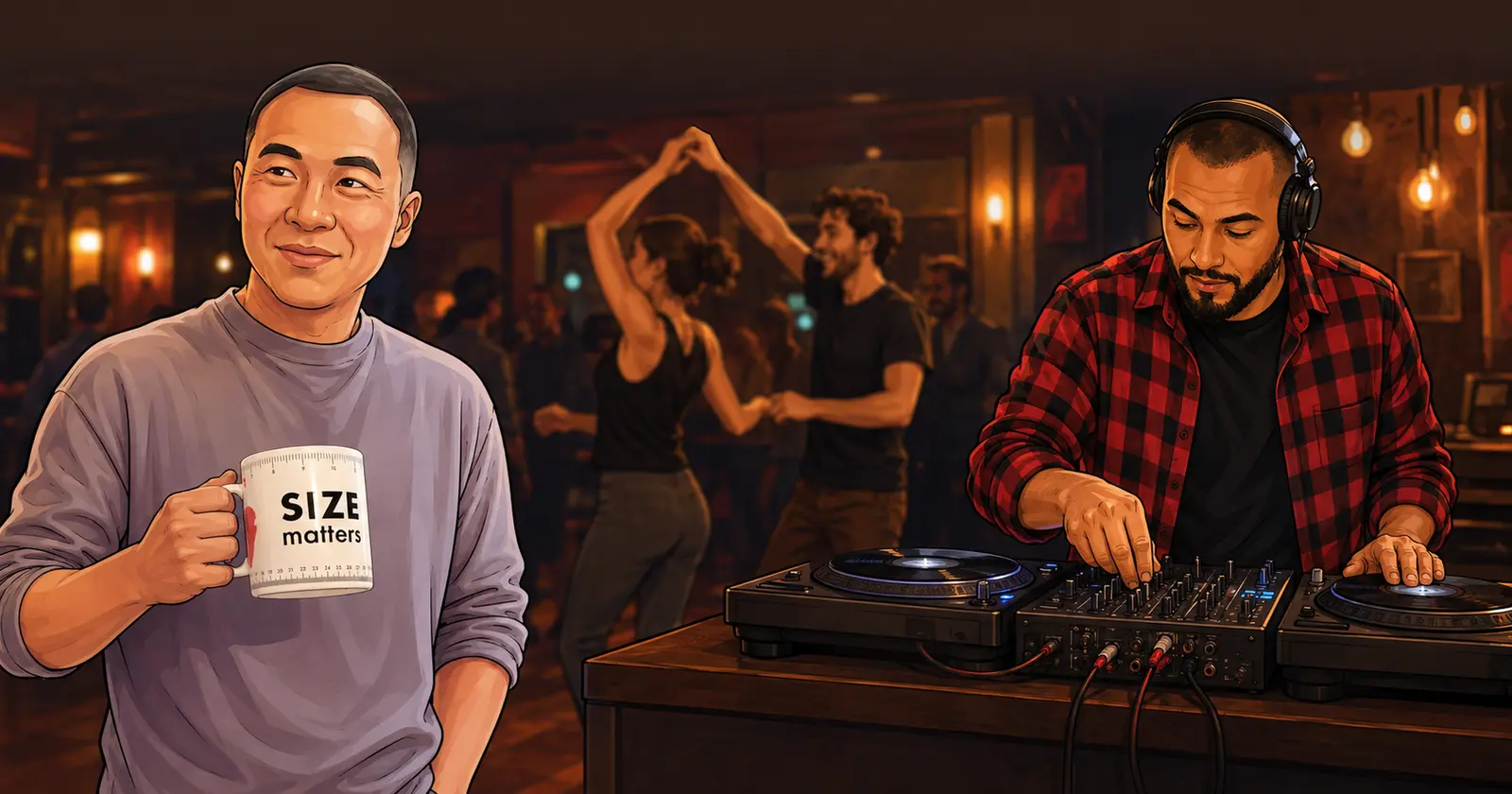
As a global community builder, one of my biggest concerns when running any kind of event is the music. Not the venue. Not the floor. Not the ticket price. The music.
Is there a good variety? Is it actually Zoukable (music you can genuinely dance Brazilian Zouk to, rather than music that happens to be playing while people shuffle about)?
There have been times where I stood there listening and thought… wtf.
Working together with Billy and other DJs, we’ve been discussing this topic quite thoroughly.
Last night is what finally inspired me to finish this blog. A terrible set of music that went on for an hour and a half.
I got there late, with only that hour and a half left of the party, and it was bad from the moment I walked in right through to the end. I have no idea if it had been going on before I arrived.
It played some weird mashups of some good commercial and mainstream music, but slapped on some out-of-sync, overbearing and overly noisy thing I can’t call rhythm, because there wasn’t any. Finding the timing was impossible, like a needle in a haystack.
I tried to ask around whose playlist this was, but the people I asked didn’t know. I danced a few songs only, sat about waiting for better music which wasn’t coming, and ended up spending the last 30 minutes dancing Zoukchata in the Bachata room. (Zoukchata is basically what I call dancing Zouk fundamentals and steps to Bachata music haha, obviously trying to stay on time. Challenge accepted!)
“But nobody dances on time anyway”
Fair shout. Look around a social and plenty of people on that floor are dancing off time, not to the music at all. So it does not really matter what gets played, right?
Wrong.
There are those of us who prefer to dance on time. Who listen. Who want the song to actually land in the body. (I went into that difference in Are you really dancing or just moving?, so I will not repeat myself here.) For those dancers, a bad set is not a small annoyance you shrug off. It is the entire night.
Some food for thoughts
Before I go further, here are 5 questions I would like you to sit with.
- If an event has a DJ and it is a paid event, does music quality matter?
- If an event has no DJ but it is still a paid event, does music quality matter?
- If an event has a DJ but the event is free, does music quality matter?
- If an event has no DJ and the event is free, does music quality matter?
- Does music quality matter if the event is held at a park, by a riverside, or inside a venue?
My answer is the same for all 5. Music matters!
The dance was created because of the music. That is the order it happened in, not the other way round and we’ve learned that from history, if you know your Lambada / Zouk Lambada / Brazilian Zouk history. So for a community to grow and be healthy, you need to play danceable songs. It really is that simple.
DJs hold the most power in the community
I mean this seriously, and I do not think it gets said enough.
DJs are the people who actually have the most power in the community to change it. Their choice and their selection dictates what the future of our community and our dance will be. Not the teachers. Not the organisers. The person picking the songs.
I wrote about this back in 2017 in The Clockworks of a Dance Scene, when I was mapping out the roles that keep a scene alive: “If more of a particular type of music is played and becomes popular with dancers, then the way we dance also starts to change and adapt.”
Almost 9 years on and I believe it more, not less.
So please, do not just play anything
Next time the thought crosses your mind, just play anything, they will not notice anyway… please don’t.
Some poor mashup which does not even mix well together, or is not in sync with the other pieces of music inside the same track because they were at different BPM (beats per minute, which is basically the speed of a song). It ends up sounding more like a fuckup than a mashup.
It kills the vibes. It kills the dance. It kills the community.
Complexity is not a flex
Songs that have too many layers of complexity are also not a great choice for dancers of any level.
Imagine having a thousand things to think about already. Your frame, your timing, your partner, the space around you, the couple about to reverse into your back. And then on top of all that you have to process multiple layers of sound that are fighting each other instead of complementing each other.
It becomes stressful trying to figure out where the timing is.
Ears bleeding from the music. Eyes bleeding from watching people dancing off time. Brain fried from processing all of this trauma. Then puking to try and exhume all that stress, and probably followed by diarrhoea as a longer term after effect.
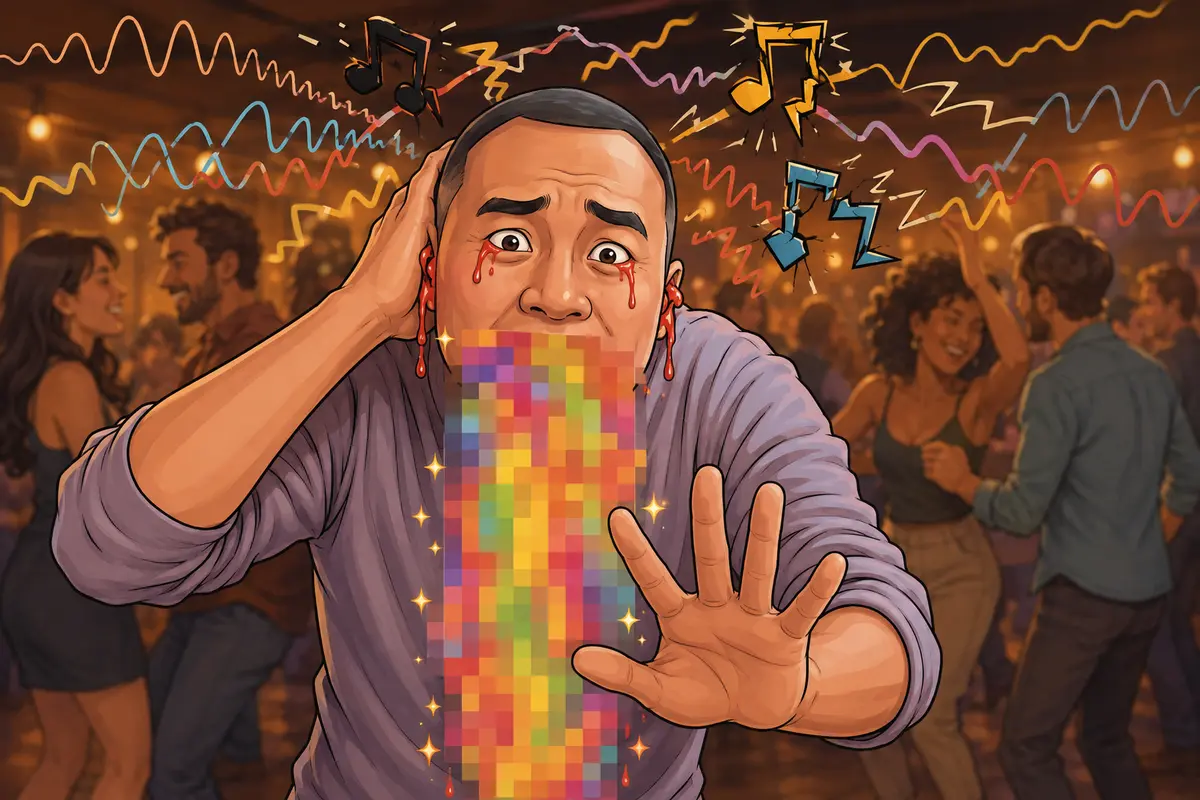
(Dramatic? A bit. But you have felt at least the first two of those, and you know it.)
KISS. Keep It Simple Stupid. Play original songs, or songs with only a few stacked instruments and rhythms. Or at the very least, make sure the tracks inside a mashup are in speed sync with each other.
Now the commercial music question
Here is another one for you. Why is it important to play more commercial music?
It is one of the reasons I deeply believe our local Brazilian Zouk community has hit a wall. The same old music, played for the same old crowd, year after year.
And what about who takes over the community in the future? One day, you and I will be old. So we need to consider who takes over from us.
Music that does not inspire or click for 18 to 30 year olds is never going to draw them in. I laid out the wider version of that problem in Why major cities struggle to grow the Brazilian Zouk dance community. The music is the part of it nobody really wants to talk about.
The 3 rules I gave my DJs
When I ran our international events, the instructions were very simple. They went to the DJ leader, who was my single point of communication.
I do not micromanage them. I should not need to, and I do not want to. I need them to bring their own unique skills and create a journey for the dancers, with their music guiding the way.
But I had 3 simple rules.
- Play anything, as long as it is Zoukable.
- No more than 3 songs of the same genre in a row.
- Experimental songs are okay, but keep it to 1 or 2 max within your hourly set.
That was it. Three lines. Everything else was theirs to own.
Who is the music actually for?
Currently, the music I hear is not being selected for the younger generations, the 18 to 30s.
Billy and I plan to change that. Target the right age group, so the Brazilian Zouk community actually has a future to hand over.
Because if the music is not bringing them through the door in the first place, nothing else we do afterwards will matter.
Music that inspires the young to dance, that is one of our goals and plan.
Be the change
I may go along with the joke that Hoi the critic is back. But this isn’t about Hoi critic, or Hoi rant. The problems I’m flagging and the thoughts I’m sharing with you are strategic considerations and suggestions on problems I’ve been seeing around the world for a long time, which still have not been acknowledged, addressed or fixed.
We need to stop walking on egg shells on these problems and start addressing them firmly, by taking actions and changing things.
And it’s fine if community leaders don’t want to change. I’m forming a team to implement these changes anyway.
Otherwise we become a dying breed.
Change or be left behind. It’s that simple.