The Fast Food Mentality. What Happened to Patience?
An interesting video popped up on my LinkedIn feed recently. I actually clicked it and watched the entire thing, which is rare for me these days.
It said Gen Z is the first generation where intelligence has gone backwards, after about a hundred years of it going up. Screens got the blame. Phones, digital distraction, too much tech in schools.
Shocking, but not shocking.
So I went and checked it.
It’s half right, and the half it got wrong matters. The decline is real and it has been measured properly. But it starts with people my age, not Gen Z. The scores peaked in the mid seventies and I was born in 1982, so I’m already in the sliding half of it. Pointing at teenagers is a bit rich coming from me.
And the researchers who found it said, in plain English, that they don’t know what’s causing it.
Which is exactly where I am. I can see the effects everywhere. I don’t know the cause.
So that’s what this is. I’m curious, and I want to get at the truth of it. The easy answer (it’s the phones, it’s the kids) clearly isn’t it, and I’d rather keep asking than settle for something that convenient.
What I see in the schools
Behaviour in classrooms got worse after the pandemic and it stayed worse. Suspensions up, attendance down.
Teachers had their powers stripped. The government put them back once the statistics showed them it was a bad decision. They can confiscate, they can search, they can give a same day detention.
But it’s too late, the damage was already done for a generation.
In the room, different story. Abuse from pupils gets treated as part of the job. They report it and not much happens. They ring home and the parents aren’t behind them.
That’s not a law problem. That’s a backing problem.
Then someone took my phone
Someone on an e-bike took my phone and was gone.
I chased. A full mile down the road, sprinting flat out, and I could not keep up. I filed the report online and it was closed immediately. Not investigated. Closed. So I’m just another metric.
A lot of it is organised, and it’s kids doing the snatching. Quick money, today, no skill required. Somebody older takes the real cut and the kid carries the risk.
It was never the screen
The biggest shift for me is screen time and the kind of content being pushed at people.
But I’m not going to shout about screens, because the evidence doesn’t back it. Screen time barely moves the needle. Kids using devices to learn at school do better. Kids using them to mess about do worse. Same device.
So it was never the screen. It’s what’s on it, and what it’s quietly teaching people to expect.
Same word, new slop
I’ve used the word slop for years, and it amuses me that AI is what finally made it famous. Same word. Same meaning. New rubbish.
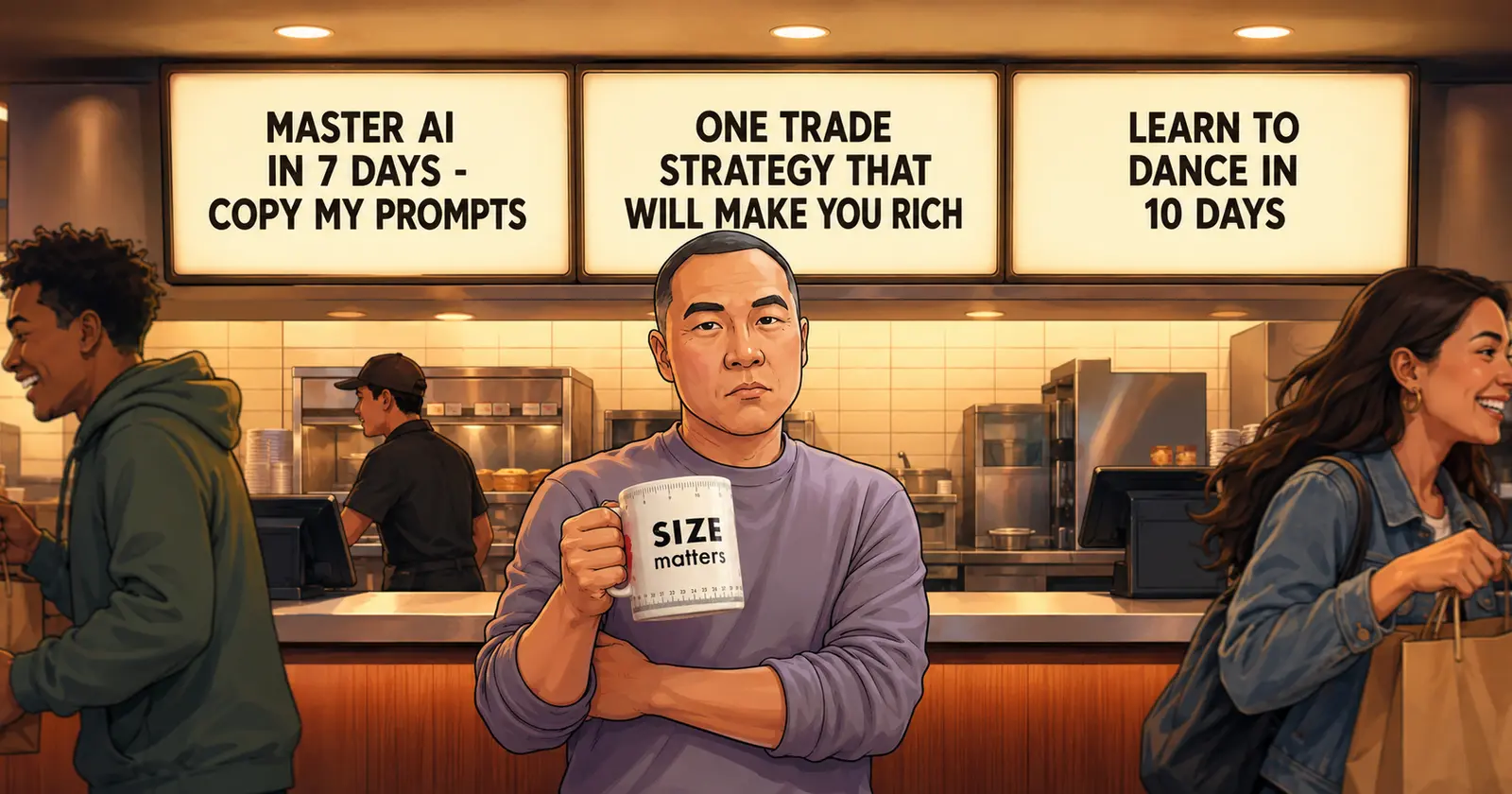
And the marketing is always the tell. Master AI in 7 days, just copy my prompts. One trade strategy that will make you rich. Learn to dance in a weekend. Build an app in a day. Drop two dress sizes by Christmas.
You getting the pattern?
The promise itself tells me exactly how bad the substance is going to be. There’s no value in any of it, because nothing they teach is sustainable, other than the next course that fixes the problem the last one created. Give a man a fish and he’s back tomorrow.
The influencer thing
Somewhere along the way, becoming an idol with millions of followers turned into a career path.
Some of it I genuinely get. If someone has a real skill and they’re passing it on properly, brilliant.
But a lot of it I don’t get at all. You get people presenting themselves as AI engineers who have no foundation in engineering of any kind. None. And they’ll teach you anyway, confidently, to an audience of thousands.
Most of them, not all, are simply chasing the click. They are not there to solve your problem. They’re closer to vultures, circling your insecurities and whatever mess you happen to be in at the time.
That’s the lot that drives me nuts.
And look, I’m not having a go at anyone who bites. When people are desperate they do stupid things. I’ve done it myself, so I’m not sitting up here judging anybody.
Clickbait and marketing ploys
What I don’t understand is why there are no rules around any of it.
I know about age. What children can be shown, what material can be put in front of them, all of that is heavily regulated, and rightly so. That is not the bit I’m talking about.
I’m talking about the fact that there is nothing out there to stop a charlatan selling you a service, a product, or plain slop dressed up as fact. It’s the wild west.
To me that is false advertising, plain and simple, and it should sit under the same law as everything else does. Put a claim like that on a product and you would be in trouble. Put it on a video and it’s absolutely fine.
Back when I was learning and doing Amazon FBA products, there were a lot of gurus teaching the marketing side of it. They actually advised using words like researchers confirmed it, experts discovered it, it was tested and the results were positive. And they said it out loud. Buyers don’t check. They will believe you if you just make up that an expert or a researcher did the work, as long as nobody gets hurt.
That got me thinking. Wow. This whole business concept, the marketing, the selling, it’s just a big sham.
We can’t paint everyone with the same colour though. I’m talking about the ones using these tactics and ploys, and they are obvious, because their “research” and their “expert” have no backing to it. That’s easily checked with a simple search online. Even easier now, get an AI to do a quick fact check.
And this is why I’ve become so skeptical with a lot of marketing ploys and clickbaits. Once you learn these things, you can’t unlearn it. lol
The platforms allow it because it’s their traffic. And the way it works right now, the burden lands on us. Something goes wrong, off you go and sue somebody, after the damage is already done. That’s a cure, not prevention.
And it isn’t just the little guys doing it. Big companies make the same claims about how effective their products or services are. Insurance, finance, big pharma, and plenty of others selling physical products, sportswear, equipment, diet, whatever it happens to be. They know a lawsuit takes a long time, and by the time anyone can hold them accountable they have already generated enough profit to cover it.
And these are the ones with substantial researches and data behind them. Even that can be manipulated to paint a more positive picture, or a more negative one, depending what their goal is.
That’s why you see them get fined. The risk reward always favours fuck it, let’s just do it, make the money, and if we get caught with our pants down then it’s just a slap on the wrist.
I get it. People post things, it isn’t advice, take it or leave it. And accountability and responsibility online is a genuinely messy problem.
But man, I hate that people can get away with it this easily, knowing full well nobody is ever going to hold them accountable for any of it.
Same problem wherever I look
In the dance community, I see it. It’s why I say most dance teachers aren’t qualified, and I’ve been saying it since 2014. Not because they can’t dance. Because they don’t understand foundation, why it matters, or how to teach it.
In the trading community, same thing. Everyone wants the one indicator.
In AI now, same again. I wrote a whole post about closing clickbait inside 60 seconds. I built my own harness because there was no shortcut to make the thing behave.
Foundation is slow. That is the point
The problem with foundation is the time it takes to lay it, and then the time it needs to set before you put anything on top of it.
At my own pace, every new skill I’ve picked up has taken a minimum of three years. That’s just to learn the fundamentals and understand how the thing actually works. The rest of my life is building on top.
That’s my pace, not a law. There is no number. Which is exactly why anyone selling you one in days is selling you nothing.
The fast food mentality
Quick relationships. Quick friendships. Quick money. Quick success. Quick food, quick delivery, quick results. Quick quick quick, I want it now.
And here comes the next gold rush, where the only people winning are the ones selling the shovels. Which has probably been true for centuries, if not millennia. lol.
Impatient.
That’s what I call the fast food mentality, and I think it’s the thing sitting underneath all of it. Not the phone. Not the generation.
Am I sure that’s the cause? No. Honestly, no. I can see the effects everywhere I look, in the schools, on the street, in three communities I’ve spent years inside, and all over social media. That includes LinkedIn. It’s like mass hypnosis or something. Or brainwashing. But I’m struggling to piece any of it together. It all just seems like noise to me, with no real correlation between any of it. If you’ve got a better answer than mine I’d genuinely like to hear it.
I’m quite the country boy. Where I grew up felt like a small town. Which makes me wonder. Is the fast food mentality a big city thing? Or is it just human nature?
Learning is a lifetime of chasing truth and knowledge, and I’m nowhere near done. Still a student. Always will be.
The good news? Patience is still available. Nobody has regulated it, nobody can sell it to you in ten days, and it works exactly as well as it always did.
Back to basics. Lay the foundation. Let it set.